
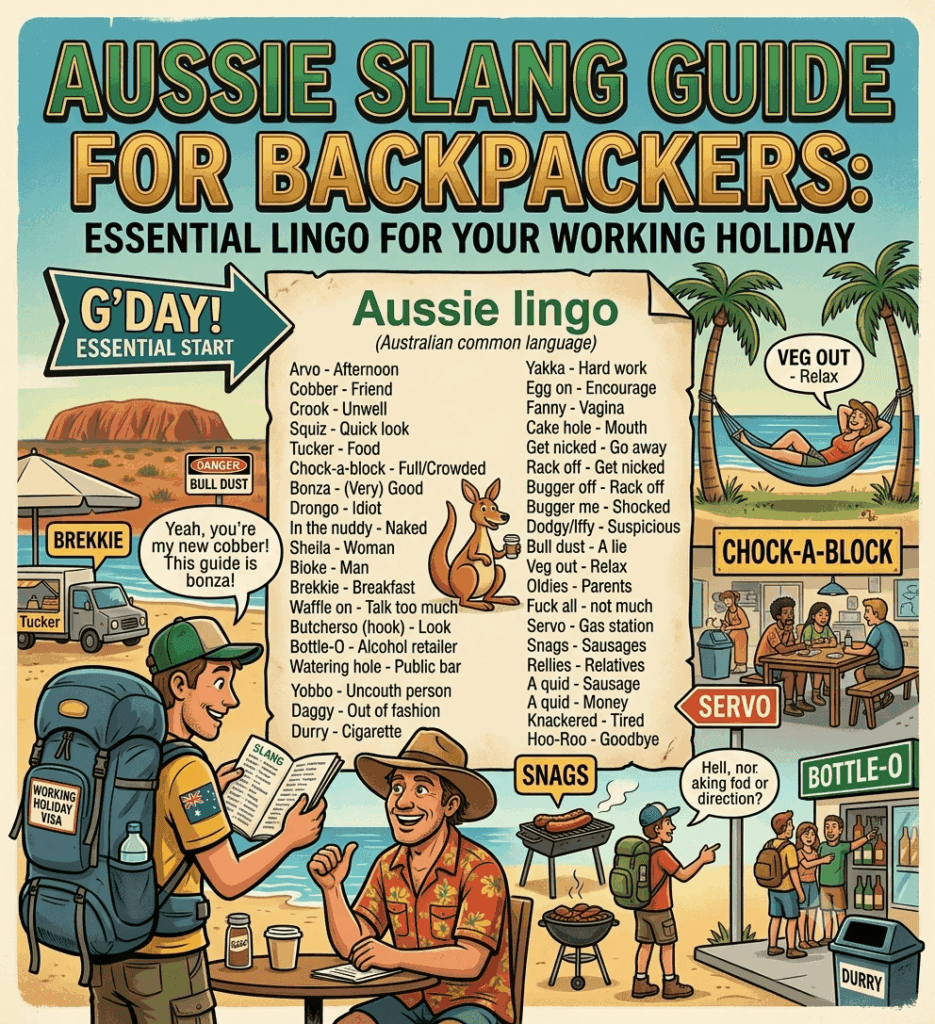
No Aussie slang guide for backpackers should begin with pleasantries — so let’s cut straight to it. You are about to work and live in a country that speaks its own version of English, and the gap between what you think you understand and what your farm manager is actually saying can cost you time, money, and your spot on the crew. Australia is a country of extremes, from the vibrant laneways of Melbourne to the vast red expanses of the outback — but no matter where your Working Holiday Visa takes you, the local lingo remains a uniquely baffling and brilliantly expressive dialect that is absolutely essential for any traveler wanting to blend in and work effectively. This guide gives you the words, the context, and the practical farm-work terminology you need to stop looking like a stunned mullet and start sounding like you belong.
Why This Aussie Slang Guide Matters for Your Working Holiday
Australian slang is far more than informal language — it is a living expression of the country’s culture, history, and deeply laid-back character. For a working holiday maker, understanding it is your key to making genuine friendships, navigating regional employment, and fully engaging with the Aussie experience rather than watching it through a window.
Surviving Regional Farm Work
Picture this: you are picking bananas in the sweltering 90% humidity of Tully, Queensland, or you have been up since 4:30 AM pruning vines in Mildura, Victoria. The farm manager — the “cocky” — yells at you to “chuck the tools in the ute before smoko.” If you do not know what that means, you are slowing down the entire crew. On piece rates, where you are paid per bin or bucket rather than per hour, time is money — and not understanding a basic instruction at 6:00 AM costs everyone. A solid Aussie slang guide for your working holiday is not just useful; on the farm, it is essential.
Cultural Integration and Respect
Knowing the local slang signals to Australians that you are genuinely interested in their culture rather than just passing through. It opens doors in working hostels, regional pubs, and farm communities that remain closed to travelers who never make the effort.
Ease of Daily Communication
Australians use slang constantly — not occasionally in moments of excitement, but as the default register of everyday speech. Understanding it prevents the kind of awkward nodding that leads to misunderstood instructions, missed social cues, and the general feeling of being perpetually slightly lost.

The Backpacker’s Dictionary: Essential Australian Slang
This Australian slang guide for backpackers is split into two sections: everyday travel terms and the specific farm work and regional lingo you will need for your 88 days. Learn both.
Everyday Essentials
- G’day — the classic greeting. Used at any time of day, in any situation, by any Australian.
- Arvo — afternoon. (“See you this arvo!”)
- No worries — no problem, everything is fine. The unofficial national motto and the correct response to approximately 80% of all apologies.
- Thongs — flip flops. Critical warning: do not confuse this with underwear. Do not tell an Aussie you got a blowout in your thong unless you are talking about your footwear.
- Sanga — a sandwich. Often spotted at the iconic “Bunnings Sausage Sizzle.”
- Tinnie — a can of beer, or a small aluminium boat. Context is everything.
- Oz — Australia.
- Bloke — a man.
- Sheila — a woman. Slightly old-fashioned but still common in regional areas.
- Bogan — someone perceived as unsophisticated. Often used affectionately between friends.
- Mozzie — mosquito. You will use this word constantly in the tropics.
- Servo — petrol station.
- Esky — a portable cooler or ice box. Essential for field lunches in summer.
- Bring a plate — if invited to a hostel BBQ and told to “bring a plate,” do not arrive with an empty dish. This means bring food to share.
Farm Work and Regional Survival Slang
- Smoko — your morning tea or cigarette break. When you hear “smoko,” drop your tools immediately and rest. Missing smoko is a rookie mistake.
- Ute — a utility vehicle (pickup truck). You will spend a significant amount of your regional working life throwing gear into the back of one of these.
- Hard yakka — hard, physical work. If a farmer tells you a job is hard yakka, believe them and adjust your expectations accordingly.
- Cocky — a farmer or farm owner. Treat the cocky with respect; they decide whether you get your 88 days signed off.
- Fair dinkum — genuine, real, truthful. (“Are you fair dinkum about showing up on time?”)
- Chook — a chicken. Relevant if you end up on a poultry farm.
- Knock off — to finish work for the day. One of the best phrases in the entire dictionary.
- She’ll be right — everything will work out fine. You will hear this from your farm manager whenever a tractor breaks down at 5:30 AM.
Gearing Up: Looking the Part to Match the Lingo
Speaking like a local is only half the equation — you also need to arrive looking like someone who is genuinely ready to work. Rolling up to a dusty melon farm in designer sneakers and a festival singlet will undo every bit of credibility your newly acquired slang has built. Regional farm work requires durable, purpose-built clothing and equipment designed for the brutal Australian sun and harsh working conditions.
You will need high-visibility work shirts, steel-capped boots, fly nets for Far North Queensland, wide-brim hats, and heavy-duty water containers for 40-degree days. Before you head bush, make sure you are properly outfitted by visiting the Backpack Australia Resources Page for recommended packing lists and gear guides built specifically for Australian regional work.
Tips for Using Aussie Slang Without Sounding Like a Bad Movie Extra
Learning the words is step one. Using them naturally and in context is the actual skill — and this backpacker Aussie slang guide would be incomplete without the practical application advice.
- Listen before you speak — Australians are famously easy-going and talkative. Listen closely to how slang is used in context before deploying it yourself. Timing and tone matter as much as vocabulary.
- Shorten everything — the golden rule of Australian English is aggressive abbreviation. If a word has more than two syllables, an Australian has probably cut it in half and added “-o” or “-ie” to the end. Afternoon becomes arvo, mosquito becomes mozzie, service station becomes servo, biscuit becomes biccy.
- Practice without embarrassment — Australians genuinely appreciate the effort. If you get something wrong or mispronounce it, they will laugh with you and correct you cheerfully.
- Know your context — some expressions that are perfectly acceptable between mates at a pub are highly inappropriate in a formal employment context or visa-related meeting. Read the room.
Our team’s practical experience helping travelers prepare for regional jobs consistently shows that rolling into a new farm placement and confidently asking the boss where to “chuck your esky” breaks the ice instantly and signals that you are adaptable and genuinely engaged — which is exactly the impression that gets you invited back for a second season.
Overcoming Language Barriers and Thick Regional Accents
Even with a solid Aussie slang vocabulary as a backpacker, thick regional accents and the background noise of tractors and packing sheds can still cause real confusion. These habits protect you.
- Never nod blankly — if you do not understand a farm instruction, ask immediately. Most Australians will happily explain without any impatience. Nodding along to an instruction you did not understand and then doing it wrong is far more disruptive than asking for clarification.
- Use body language as backup — when noise or accent makes verbal communication difficult, gestures bridge the gap effectively.
- Keep a reference handy — save a slang reference app or document on your phone for the first few weeks until the most common terms become second nature.
The Tourism Australia official guide to Aussie slang is a useful supplementary reference that covers additional terms and cultural context directly from the source.
Frequently Asked Questions: Aussie Slang for Backpackers
Do I really need to use slang to get a farm job?
You do not need to use it yourself from day one, but you absolutely must understand it. Farm managers and hostel staff speak quickly and use slang as their default register. Understanding words like “smoko,” “ute,” and “hard yakka” ensures you can follow safety instructions and work efficiently from your very first shift.
Are Australians offended if I do not understand their slang?
Not at all. Australians are notoriously easy-going about this. Simply say “Sorry mate, what does that mean?” and most will laugh and translate into plain English immediately. The effort to ask is always appreciated over the alternative of nodding along in confusion.
What does “bring a plate” mean?
If you are invited to a hostel BBQ or local gathering and told to “bring a plate,” do not arrive with an empty ceramic dish. It means bring a plate of food to share with the group — an essential piece of cultural knowledge that will save you significant embarrassment at your first working hostel social event.

Knock Out Your 88 Days Fast and Start Earning
You now have the Aussie slang guide every backpacker needs — but lingo alone will not find you legitimate regional work. Every year, thousands of working holiday makers make the same expensive mistake: they try to find farm placements independently, waste weeks scrolling through unreliable Facebook groups, and burn through their savings sitting in city hostels while missing out on thousands of dollars in potential wages.
Backpack Australia has direct, established contact with over 4,000 eligible regional employers and connects with virtually all the legitimate working hostels across the country. We put you directly in front of reliable farmers who need workers right now — no scams, no dead ends, no wasted weeks. Knock out your 88 days fast, start earning immediately, and get back to experiencing everything this extraordinary country has to offer.
Sign Up for the Job Help Programme Newsletter to get immediate access to our exclusive employer and hostel networks today.
Conclusion
Mastering the Aussie slang guide every backpacker needs is your fast-track entry into an authentic Australian experience — on the farm, in the hostel, at the pub, and everywhere in between. The language is not just fun; it is functional. It gets you hired, keeps you safe, and signals to every Australian you meet that you are genuinely here, genuinely engaged, and genuinely ready to put in the hard yakka. Slap on your thongs, grab a tinnie, and get out there — good luck, mate.